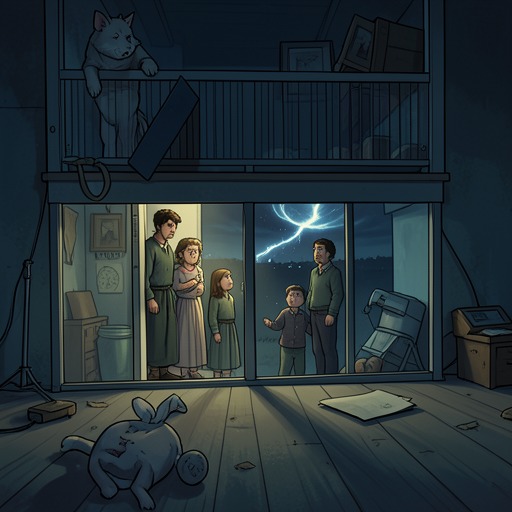
A sudden loud noise near the vacation house
Leave the World BehindA sudden loud noise near the vacation house turns an ordinary pause into a physical and psychological rupture. It has no identified source and receives no satisfactory explanation, yet it leaves concrete marks: a long crack in the glass door, Archie on his knees in the woods, and Amanda moving from stunned silence into a search for her children. The event matters less as a decipherable signal than as an experience that makes the limits of ordinary language and perceived safety suddenly palpable.
The Quiet Before the Noise
Amanda is sitting outside while the children play among the trees. The yard is quiet apart from the steaming movement of the hot tub; she can see the woods but cannot distinguish the children’s bodies in the greenery. Her thoughts are still within the scale of family life: she is glad the children have one another and can lose themselves in play. George is in the tub. Nothing in the scene prepares them for what follows, and the narration emphasizes that there has been no precedent by which to recognize or anticipate the sound.
That absence of warning shapes the event. It does not arrive as the culmination of an understood threat, but breaks into a setting that had offered no reason to expect it. The prose insists on the abrupt transition from nothing happening to something that cannot be assimilated as an ordinary sound. The noise is therefore a turning point in the scene before anyone knows what has caused it: the characters experience its force first and can only attempt interpretation afterward.
An Experience Without a Name
The narration tests familiar comparisons and finds them inadequate. The noise is not simply a bang or a clap; it is greater than thunder or an explosion, though the characters have never been close to an explosion. The text distinguishes hearing from enduring: this is something experienced, survived, and witnessed, not merely registered by the ear. Its suddenness and scale divide life into a period before it and a period after it, even while its meaning remains unknown.
The account also turns briefly to how understanding works. People often recognize what has happened only after the fact, then look backward through a chain of events that was invisible while they were living it. Here, however, that retrospective process cannot yet supply an answer. Calling the event a noise identifies its surface but does not explain it; the word itself seems too small for what has occurred. The passage’s repetitions and self-corrections enact that failure of description rather than resolving it.
Immediate Effects
The sound’s aftereffect seems to linger in the air. Amanda stands, and the glass pane in the door between the bedroom and the deck is found to have a fine but long crack. The narration calls the fracture beautiful and mathematical, an exact mark left by an event whose larger cause is wholly unclear. It is a material consequence that can be seen even as the noise itself resists comprehension.
In the woods, Archie falls onto his bare knees. The sound is powerful enough to bring a person down, making it seem inadequate to call it merely a noise. George leaps out of the tub without covering himself with a towel. Amanda trembles and repeatedly says, “What the fuck?” Her words are not addressed to George or anyone else; they come without an answer, almost like a prayer. She feels as though she is screaming, but what emerges is a gasp. Her body registers shock before she can give it a settled name.
Amanda also wonders whether the noise has damaged her hearing or brain. She recalls reports about consular employees in Havana who developed neurological symptoms believed to be connected to noise, and recognizes that she had never considered a sound itself as a possible weapon. The reference offers no explanation for this event; instead, it widens the kinds of danger she can imagine. Her familiar reassurance that children and pets need not fear thunder no longer seems sufficient protection against an unknown sound.
The Unanswered Event and Its Turn
Amanda tries to imagine whether the noise was confined to the house or its perimeter, related to the weather, interstellar in origin, or something like a divine arrival. These possibilities remain questions, not discoveries. As she asks what happened, she already senses that no satisfactory explanation will come. The scene thus offers effects without a cause: a cracked pane, bodily disorientation, and fear, but no account that can make them orderly.
The noise changes Amanda’s stillness into urgent movement. She goes down the steps, past the pool, shoves open the gate, and runs into the grass to find the children. Though she thinks she should call for them, her voice does not work or cannot keep pace with her body. The landscape appears as a single indistinct mass of green and brown. The event’s immediate consequence is therefore not simply alarm but a collapse of distance between the unknowable sound and the intimate fear of losing sight of her children. Its meaning remains unresolved; its power is already evident in what it makes the family do and what it leaves them unable to say.